Corporate Wellness Coloring: B2B Program Formats & Pricing Ideas
Corporate Wellness Coloring: B2B Program Formats & Pricing Ideas
Corporate wellness coloring book hero
In the crowded corporate wellness market, tangible tools serve as powerful differentiators. Adult coloring books offering stress relief are a viable B2B solution, but success depends on choosing the right production model to ensure profitability and premium quality.
1.0 Production Strategy: Structuring the B2B Offer
The first strategic decision is choosing a production model that aligns with B2B pricing expectations.
1.1 The “Agile” Pilot: Print-on-Demand (POD)
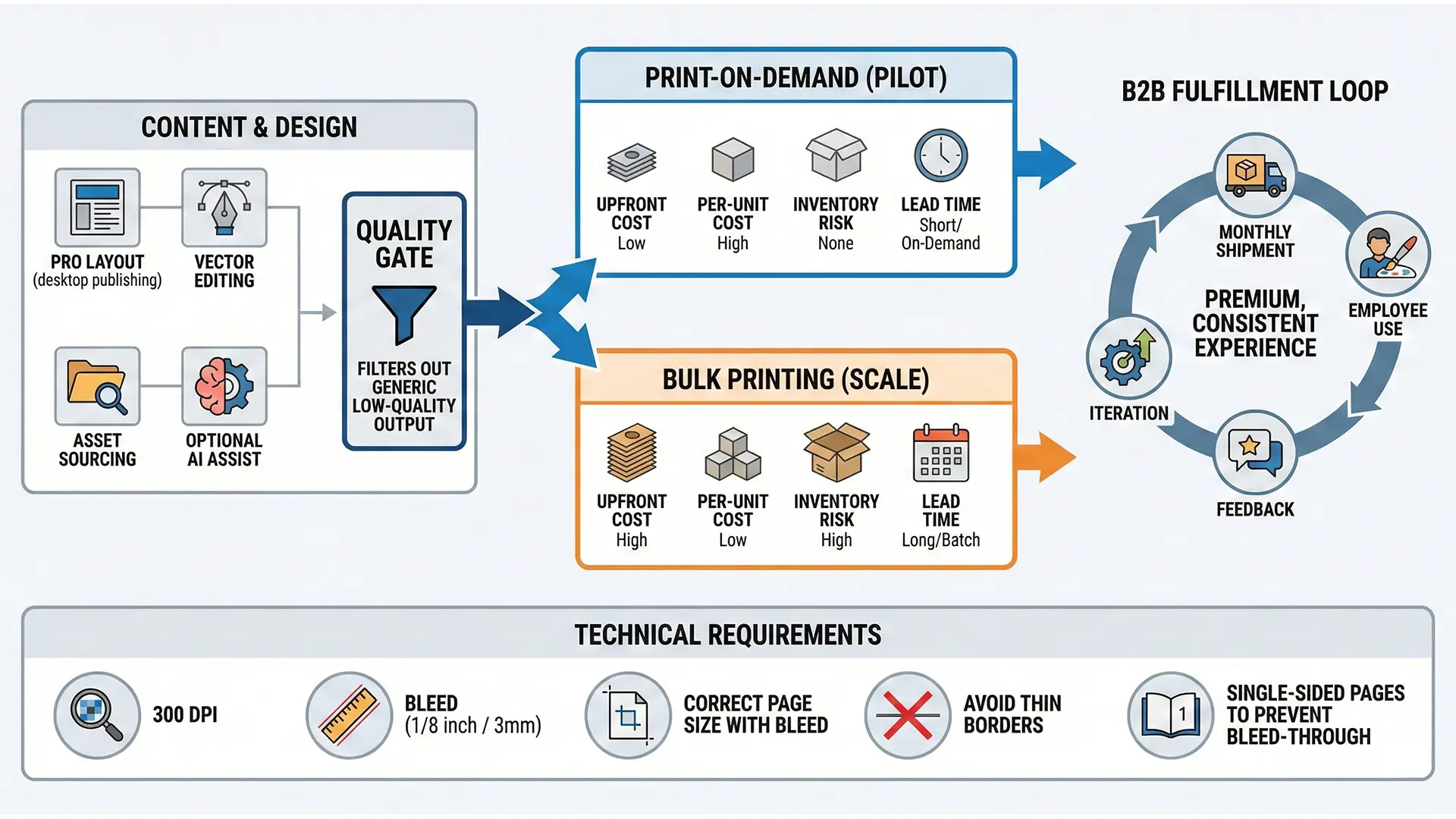
For initial B2B pilots, Print-on-Demand (POD) eliminates inventory risk. * Pros: Zero upfront cost; books are printed only when a corporate client places an order. * Cons: High per-unit costs make it difficult to offer competitive volume discounts or achieve healthy margins.
1.2 The “Scale” Solution: Bulk Printing
To offer a profitable corporate subscription service, bulk printing is necessary. * Pros: Ordering 1,000+ copies (often from China) lowers per-unit costs significantly, enabling retail pricing in the $3.99–$5.99 range. * Cons: Requires capital investment and logistics for storage/shipping.
Comparative Analysis for B2B Programs
| Feature | Print-on-Demand (Pilot) | Bulk Printing (Scale) |
|---|---|---|
| Upfront Cost | Very Low / None | High (Capital Investment) |
| B2B Margin Potential | Low (High print costs eat margin) | High (Low unit cost allows profit) |
| Inventory Risk | None | High (Unsold stock) |
| Flexibility | High (Good for testing custom covers) | Low (Long lead times) |
2.0 Content & Design: The Premium Differentiator
For a B2B product, quality is paramount. Corporate clients will not accept generic or low-quality materials.
2.1 Tool Selection
- Professional Standard: Tools like Affinity Publisher (now owned by Canva) or Adobe InDesign offer maximum control for branded layouts.
- Efficiency: AI tools like
createcoloringbooks.aican speed up production, but use with caution.
2.2 The “AI Slop” Risk
Avoid “AI slop” (low-quality generated images) at all costs. Associating a corporate brand with poor-quality AI art can devalue the product and damage reputation. Content must be curated to ensure a premium feel suitable for HR wellness packages.
3.0 Technical Specs: Professional Execution
A physical product reflects the brand’s standards. Flaws like white borders or blurry lines signal amateurism.
Corporate coloring book technical specifications
3.1 Non-Negotiable Specifications
- Bleed: You must extend artwork 0.125 inches (3mm) beyond the trim line. For an 8.5”x11” book, the file size must be 8.625” x 11.25” to ensure a perfect edge-to-edge finish.
- Resolution: All images must be 300 DPI. Higher resolutions (e.g., 600 DPI) can cause issues, while lower ones look pixelated.
- User Experience: Use single-sided pages. Leave the reverse side blank to prevent ink bleed-through, creating a premium experience for employees using markers.
4.0 Rollout Playbook: From Pilot to Subscription
To launch a B2B coloring solution effectively, follow this strategic framework:
- Phase 1 (Validation): Use Print-on-Demand to test the concept with a few corporate clients. This minimizes financial risk while gathering feedback.
- Phase 2 (Expansion): Once demand is proven, transition to Bulk Printing. This is the only way to secure the margins needed for a sustainable B2B subscription model.
- Quality Control: Regardless of the model, strictly adhere to technical specs (Bleed/DPI) to maintain “Corporate Grade” quality.
Quick Checklist (B2B Launch)
- Model: Selected POD for pilot or Bulk for scale?
- Design: Vetted content to ensure it is not “AI Slop”?
- Tech: Document set to 8.625” x 11.25” (with bleed)?
- Quality: Resolution set to 300 DPI?
- Layout: Interior pages set to single-sided?