Digital Coloring for Mental Health & Wellness: Programs & Use Cases
Digital Coloring for Mental Health & Wellness: Programs & Use Cases
Digital coloring for mental health hero illustration
The adult coloring book market has evolved from a simple pastime into a widely recognized tool for promoting mental health, reducing stress, and practicing mindfulness. For independent creators, this flourishing wellness niche presents a significant opportunity to build therapeutic resources, provided they navigate the technical and strategic challenges of publishing.
1.0 The Creator’s Toolkit: Building Wellness Resources
Selecting the right software is a strategic decision that impacts workflow efficiency and the final quality of a therapeutic product.
1.1 The New Powerhouse: Affinity by Canva
In 2025, the landscape shifted when the Affinity suite (Publisher, Designer, Photo) was unified into a single application owned by Canva. This tool now operates on a freemium model, integrating Canva’s AI-powered features like background removal for Pro subscribers. This makes it a formidable, integrated option for independent publishers.
1.2 Industry Standards vs. Specialized AI
- Adobe InDesign: Remains the industry leader for complex layouts but comes with a subscription cost and a steeper learning curve.
- Specialized Tools: Platforms like CreateColoringBooks.ai automate cover creation and image generation.
- Utilities: Image DeColouriser is effective for stripping color from cartoon-style images to prepare them for coloring formats.
2.0 Sourcing Content: “Therapy-Adjacent” Quality
The origin of your artwork influences market appeal and “wellness” credibility.
| Method | Pros & Cons |
|---|---|
| Hand-Drawn | High Originality. Creates a defensible brand. Example: The viral success of ‘Cats Being Dicks’ was due to a unique style impossible to replicate with generic assets. |
| AI-Generated | Speed & Cost. Fast production, but risks being perceived as “AI slop” and cannot be copyrighted. |
| Stock Assets | Affordable. Licensed assets from Canva/Creative Fabrica are cheap but lead to generic, non-unique interiors. |
3.0 Technical Precision: Ensuring a Stress-Free User Experience
A “therapeutic” book must not cause frustration through poor production quality. Technical precision is non-negotiable.
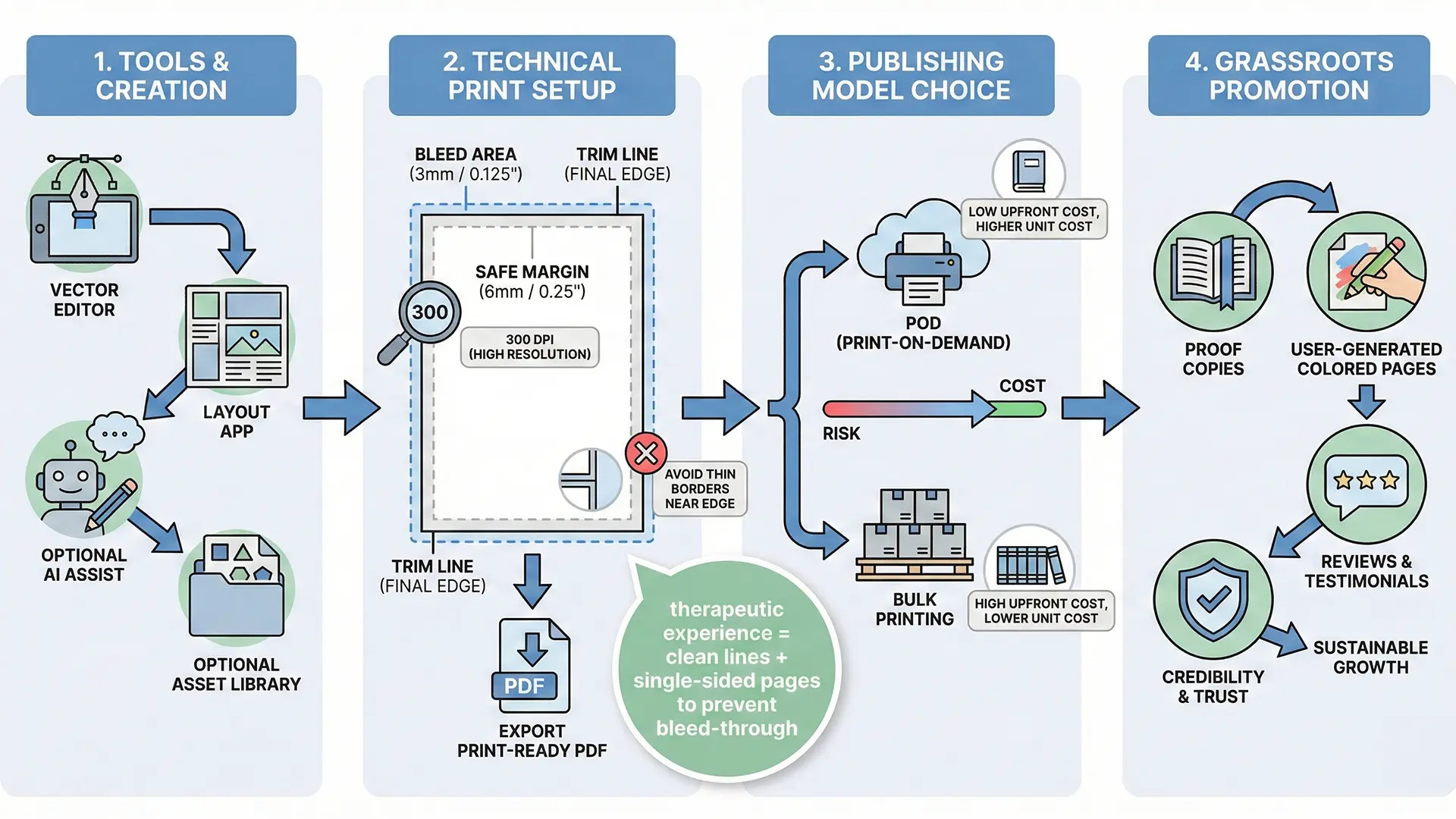
Wellness coloring book technical specifications diagram
3.1 Print Bleed and Trimming
“Bleed” ensures artwork extends beyond the trim edge to prevent white borders due to paper movement during cutting. * The Rule: The standard bleed dimension is 1/8 of an inch (0.125”) on the top, bottom, and outside edges. * Example: An 8x10 inch book with full bleed must be sized to 8.125” x 10.25”.
3.2 Resolution and Layout
- 300 DPI Standard: Submitting files higher than 300 DPI is not beneficial and can paradoxically cause jagged lines when resized.
- Single-Sided Pages: To prevent ink bleed-through (a major stressor for users), print designs on only one side. Include a note on the reverse: “This page intentionally left blank to prevent bleed-through”.
- No Borders: Avoid printed borders, as KDP cannot guarantee perfectly even cuts, leading to a lopsided appearance.
4.0 Distribution Models: POD vs. Bulk
The choice between Print-on-Demand (POD) and bulk printing dictates your risk and pricing strategy.
- Print-on-Demand (Amazon KDP): Eliminates inventory risk and upfront costs, but is the most expensive way to produce books per unit. This usually results in higher retail prices and lower royalties.
- Bulk Printing (Offset): Used for books priced at $3.99–$5.99. Requires ordering 1,000+ copies from overseas (China/Southeast Asia) to secure low per-unit costs, carrying high inventory risk.
5.0 Marketing for Wellness: Grassroots Strategies
To launch a wellness book without a large budget, rely on social proof and community.
- Leverage Proof Copies: Order author proofs at cost and gift them to friends who enjoy coloring.
- User-Generated Content (UGC): Ask recipients to post photos of their finished pages on social media to create authentic endorsements.
- Launch Pricing: Set the initial price just above printing cost to drive volume and accumulate reviews, then raise the price for profitability later.
Quick Checklist (Therapeutic Book Launch)
- Tooling: Selected Affinity (Freemium) or InDesign for layout.
- Content: Verified artwork is not generic “slop” to ensure brand defensibility.
- Tech Specs: Document sized with 0.125” bleed and 300 DPI resolution.
- UX: Layout set to single-sided to prevent bleed-through.
- Marketing: Distributed proof copies to generate initial social media content.