How To Price Bundled Coloring Books For Profit
How To Price Bundled Coloring Books For Profit
Bundling coloring books can boost profits by increasing the average order value (AOV) and offering customers perceived value. To price bundles effectively, focus on understanding production costs, researching competitors, and applying pricing strategies that balance profitability with customer appeal. Key considerations include:
- Production Costs: Combine fixed costs (e.g., software, design) and variable costs (e.g., printing, Amazon fees). For example, printing a 70-page book via Amazon KDP costs $1.69.
- Competitor Pricing: Single books typically sell for $7.99–$13. Bundles of three books often range from $25–$30.
- Pricing Formula: Use
(Print Cost + Target Profit) ÷ 0.60to calculate list prices, accounting for Amazon’s 40% commission. - Psychological Pricing: End prices in .99 (e.g., $24.99) to encourage purchases. Highlight discounts (e.g., "Was $30, Now $24.99").
- Testing and Adjusting: Monitor metrics like sales volume and bestseller rank to refine prices. Run biweekly experiments and adjust based on results.
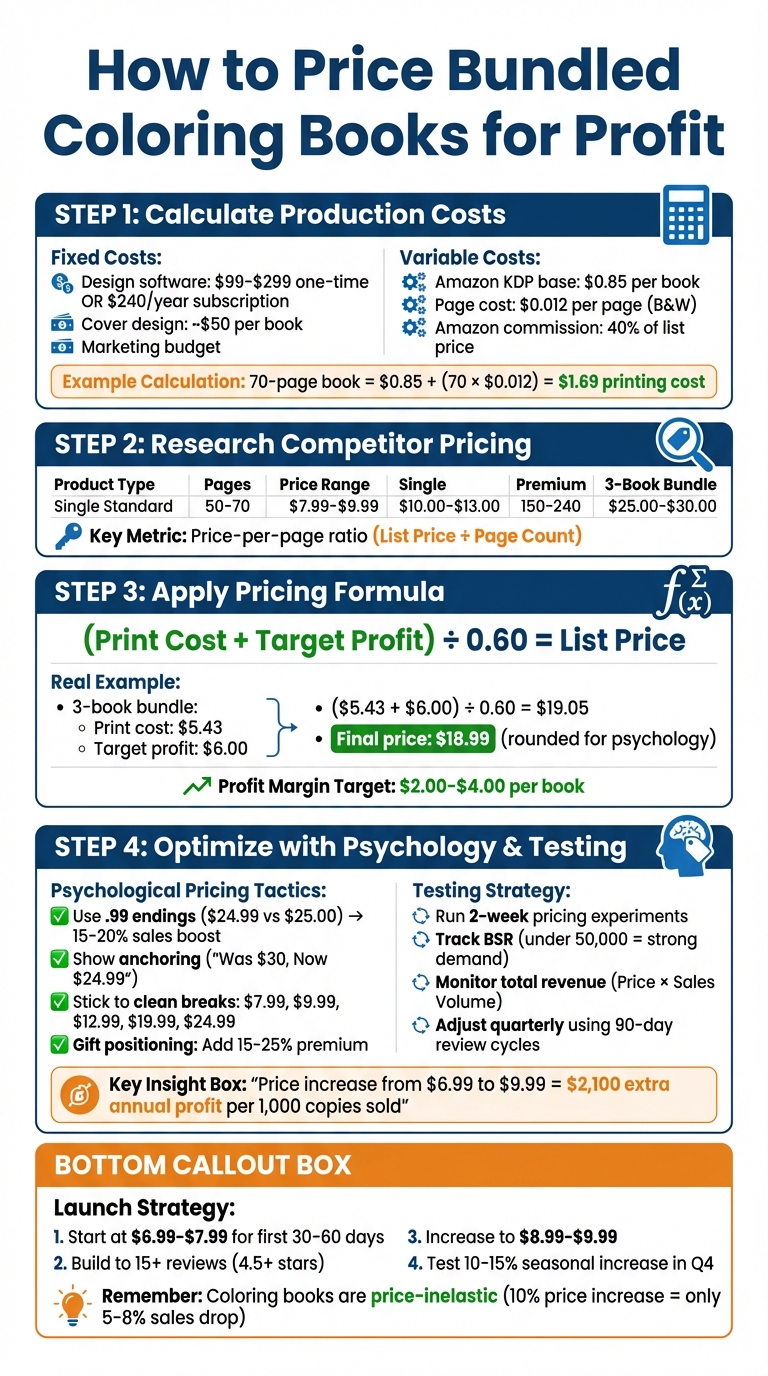
How to Price Bundled Coloring Books: 4-Step Profit Formula
Understanding Production Costs
To price a bundle profitably, you need a solid grasp of your production costs. These costs fall into two main categories: fixed costs and variable costs.
Fixed Costs: Tools and Software
Fixed costs are the upfront expenses that remain constant, regardless of how many units you sell. A key fixed cost is design software. For example, Coloring Book Engine offers a one-time payment option: $99 for personal use or $299 for organizational use. This avoids the recurring fees associated with subscription-based tools, which can cost $19.99 per month or more, adding up to $240 annually.
Other fixed costs might include professional cover design services, which typically run about $50 per book. You’ll also need to consider your marketing budget for platforms like social media or Google Ads, as well as any business essentials like branding materials. Spreading these fixed costs across your sales helps maximize your profitability.
Variable Costs: AI Usage and Printing
Variable costs, on the other hand, increase as you produce and sell more units. If you’re using Amazon KDP for print-on-demand coloring books, the primary variable expense is printing. Amazon KDP charges a fixed base of $0.85 per book (for an 8.5x11" trim size) plus $0.012 per page for black-and-white interiors. For instance, a 70-page coloring book costs $1.69 to print, while a 200-page book costs $3.25.
It’s best to stick with black-and-white interiors for these books - color printing costs $0.060 per page, which is about five times more expensive and doesn’t add value since customers color the pages themselves. If you’re using AI tools with a "Bring Your Own Key" (BYOK) model, like the one supported by Coloring Book Engine, you’ll also need to account for API costs per image as part of your variable expenses. Additionally, Amazon takes 40% of your book’s list price under its standard distribution terms, so that needs to be factored into your calculations.
By understanding these variable costs, you can better plan your pricing strategy.
Calculating Total Production Costs
To accurately price bundles, calculate the total cost per unit using this formula: Fixed Cost + (Page Count × $0.012) + AI Costs. For example, let’s say you’re bundling three books with 70, 80, and 90 pages each. The printing costs would be $1.69 + $1.81 + $1.93, totaling $5.43.
Next, add your target profit margin. Aiming for $2.00–$4.00 per book keeps your pricing competitive. Then, divide the sum by 0.60 to account for Amazon’s 40% commission. Using this formula: ($5.43 + $6.00 target profit) ÷ 0.60 = $19.05 list price. To optimize sales, round down slightly to $18.99 - psychological pricing like this can increase sales by 15–20% compared to round numbers.
sbb-itb-c02bfb4
Researching Competitor Pricing
Before setting your bundle prices, it’s important to understand the market trends. This includes staying updated on adult coloring book market trends to ensure your pricing remains competitive. Start by searching Amazon with specific keywords tailored to your niche, combined with terms like "bundle" or "set." For example, instead of just typing "coloring books", try something more precise like "French bulldog coloring book set" to find your direct competitors.
To identify what’s working, sort the results by "Best Selling" to uncover products that are gaining traction. Tools like AMZScout PRO AI Extension or Book Bolt can help you analyze the competition and benchmark pricing strategies effectively.
Comparing Single Book vs. Bundle Prices
Single coloring books typically fall in the $7.99 to $9.99 range, making them attractive impulse buys. However, premium or niche-specific books often command higher prices, ranging from $10 to $13. When it comes to bundles, three-book packs are commonly priced between $25 and $30.
To gauge the value of a product, calculate the price-per-page ratio by dividing the list price by the page count. For instance, an $8.99 book with 70 pages has a per-page cost of approximately $0.128. Reviewing the top 10 competitors in your niche - focusing on their page counts and prices - can help you pinpoint the ideal pricing "sweet spot" for your bundle.
| Bundle Type | Pages | Price Range | Target Audience |
|---|---|---|---|
| Single Standard | 50-70 pages | $7.99 - $9.99 | Impulse buyers |
| Single Premium | 70-100 pages | $10.00 - $13.00 | Niche enthusiasts |
| 3-Book Bundle | 150-240 pages | $25.00 - $30.00 | Gift buyers/Collectors |
Identifying Pricing Patterns in Bundles
Many sellers use strategies like the loss leader approach, where the first book in a series is priced lower (around $7.99) to attract buyers, with subsequent books priced higher, typically between $8.99 and $10.99. Another common strategy is value tiering, offering a "Starter" version with 50 pages for $7.99 and an "Ultimate" edition with 100+ pages for $12.99.
Pay attention to these patterns among your competitors, as they can provide valuable insights for structuring your own pricing. Use these strategies to create a pricing model that not only appeals to your target audience but also maximizes your profitability.
Setting Profitable Prices for Bundled Coloring Books
Once you're familiar with your production expenses and market trends, the next logical step is determining prices that ensure a healthy profit.
Pricing Formula for Profit Margins
To set accurate prices, start with a formula that accounts for all costs and your desired profit margin. Here's a reliable formula: (Print Cost + Target Profit) ÷ 0.60 = List Price. The 0.60 represents your 60% royalty, as Amazon retains 40% of the list price.
Let’s break it down with an example: If a three-book bundle costs $5.10 to print and you aim for a $10.00 profit, the calculation would be ($5.10 + $10.00) ÷ 0.60 = $25.17. You could then round it to $24.99.
While print bundles follow tighter cost structures, digital bundles offer much higher margins, often around 90–95%. For instance, a $9.99 digital bundle nets approximately $9.69 after a small 3% fee. This makes digital bundles a strong choice for maximizing profits while keeping prices competitive.
Once you’ve calculated the base price, the next step is to adjust it to reflect the size of the bundle.
Adjusting Prices Based on Bundle Size
For multi-book bundles, offering a 15–30% discount can strike a balance between maintaining profits and providing perceived value. For example, if single books are priced at $9.99 each, a three-book bundle might be priced between $25.00 and $27.00 instead of $29.97.
Another strategy to build customer loyalty is the "Series Pricing Pyramid." Start with the first book as a loss leader at $7.99 to attract buyers, then price subsequent books slightly higher, at $8.99–$9.99. When customers are ready to buy the entire series as a bundle, they’ll feel they’re getting great value since they've already tested the quality of your first book.
You can also offer tiered bundles to cater to different budgets and preferences. For instance:
- A "Starter" bundle with 50 pages per book at $7.99
- A "Complete" version with 70 pages at $9.99
- An "Ultimate" edition with 100+ pages at $12.99
After adjusting for size and tiers, fine-tune your pricing with psychological strategies.
Applying Psychological Pricing
Psychological pricing techniques, like charm pricing, can significantly influence buying decisions. For example, pricing a bundle at $24.99 instead of $25.00 can boost sales by 15–20%. That’s because customers perceive $24.99 as being in the "$24 range" rather than "$25 range".
Avoid "in-between" prices that confuse buyers. Instead, stick to clean price breaks like $7.99, $9.99, $12.99, $19.99, or $24.99. These numbers feel intuitive and make decisions easier for customers.
Anchoring is another powerful tool. Highlight the original price alongside the discounted price (e.g., "Was $30, Now $24.99") to emphasize savings. This comparison makes the discount feel tangible and reinforces the idea of getting a deal. If you're marketing bundles as gifts, consider pricing them 15–25% higher than standard listings. Shoppers buying gifts are often less sensitive to price differences.
| Pricing Strategy | Example | Impact |
|---|---|---|
| Charm Pricing | $24.99 vs. $25.00 | Boosts sales by 15–20% |
| Anchoring | "Was $30, Now $24.99" | Highlights savings and value |
| Gift Positioning | $12.99 vs. $9.99 | Allows a 15–25% premium |
| Clean Price Breaks | $7.99, $9.99, $12.99 | Simplifies decision-making |
Testing and Improving Your Pricing Strategy
Pricing isn’t a one-and-done decision - it’s an ongoing experiment that requires careful monitoring and regular tweaks.
Tracking Sales Data and Metrics
Amazon’s tools like KDP Reports and Amazon Author Central are your go-to for tracking key metrics. Pay attention to sales volume, total revenue, BSR (Bestseller Rank), and conversion rates. While it’s easy to focus on royalty per book, total revenue (Price × Sales Volume) is what truly matters.
"Total revenue matters more than royalty per book. A $14.99 book earning $5 per sale with 100 monthly sales ($500 total) beats a $19.99 book earning $8 per sale with 50 monthly sales ($400 total)." - BookBloom
Your BSR can also guide your pricing strategy. A rank under 50,000 suggests strong demand, making it a good time to test higher prices. On the flip side, a BSR above 500,000 might mean it’s time to lower prices to speed up sales. Running two-week pricing experiments can help you zero in on the ideal price point. Interestingly, coloring books are generally price-inelastic - a 10% price increase usually results in only a 5–8% drop in sales.
| Metric to Track | Tool/Source | Purpose |
|---|---|---|
| Sales Velocity | KDP Reports | Measures how quickly books sell at different prices |
| Conversion Rate | Amazon Author Central | Evaluates if the price is turning clicks into buyers |
| Bestseller Rank (BSR) | Amazon Product Page | Reflects market demand and pricing competitiveness |
| Total Revenue | Manual Calculation | (Price × Sales Volume); the ultimate pricing metric |
These insights can guide not only your pricing but also your promotional efforts.
Promoting and Upselling Bundles
Launch pricing is a smart way to kickstart sales. For new bundles, start with a price of $6.99–$7.99 for the first 30–60 days. This helps generate reviews and sales momentum. Once you’ve built some social proof, increase the price to the typical market range of $8.99–$9.99. Early buyers are often less price-sensitive, making this strategy effective for gaining traction.
Bundling physical and digital versions is another way to boost value. With 64% of buyers open to purchasing both formats, offering a digital version as a bonus with the physical book can make your product more appealing without significantly increasing costs. Additionally, free sample pages (5–10 pages) can act as lead magnets to grow your email list, setting you up for future promotions.
These tactics not only enhance perceived value but also pave the way for data-driven price adjustments.
Adjusting Prices Based on Results
Once you’ve gathered data from promotions and initial tests, refine your pricing strategy. For example, if your bundle maintains a BSR under 50,000 even after hitting bestseller status, you can experiment with higher price points like $10.99–$11.99. On the other hand, if you’ve had no sales in 30 days, consider lowering the price to boost sales velocity and improve your Amazon ranking.
Social proof plays a big role in justifying price increases. Once your book garners 15+ reviews with a 4.5+ star rating, you can confidently charge a premium price. Use a 90-day review cycle to test different price points quarterly and compare total revenue (Price × Sales Volume) for each period. During Q4 (October–December), consider a 10–15% seasonal price increase to capitalize on holiday shoppers, who are typically less price-conscious. Return to regular pricing in January.
"The difference between a $6.99 and $9.99 coloring book? $2,100 in annual profit for every 1,000 copies sold." - KDPEasy
Conclusion and Key Takeaways
Setting the right price for bundled coloring books requires a thoughtful approach rooted in understanding your costs, researching the market, and consistently analyzing data. Start by breaking down your fixed costs (like AI vs. traditional design tools and software) and variable costs (such as printing fees and platform commissions). Don’t forget to factor in the 40% KDP commission when calculating your list price using a markup formula that ensures a solid net profit per book. This serves as the foundation for all future pricing decisions within your coloring book publishing workflow.
Competitor research is crucial for staying competitive. Generally, digital bundles are priced between $7.99 and $12.99, while print bundles range from $14.99 to $24.99. Pricing too low can make your product seem inferior, while excessively high prices can hurt conversions. To strike the right chord, use techniques like psychological pricing (e.g., ending prices in .99) and offer tiered bundles (such as Starter, Complete, and Ultimate) to cater to different buyer preferences. These strategies create a strong starting point for testing and refining your pricing.
The key to success lies in treating pricing as a continuous experiment. Keep a close watch on metrics like Best Seller Rank, conversion rates, and total revenue, and run biweekly tests to fine-tune your price. Coloring books tend to be relatively price-inelastic, meaning a 10% price hike usually leads to only a 5–8% drop in sales. Once your product garners over 15 reviews with an average rating above 4.5 stars, don’t hesitate to raise your prices.
Small pricing adjustments can have a big impact. For example, increasing a bundle’s price from $6.99 to $9.99 could add an extra $2,100 in annual profit for every 1,000 copies sold. Start with a launch price in the $6.99–$7.99 range to attract early buyers, then transition to market rates as your reviews and sales grow. During Q4, consider testing a seasonal price increase of 10–15% to take advantage of holiday shoppers who are less sensitive to pricing.
Ultimately, your pricing strategy should evolve alongside your business. Use quarterly 90-day review cycles to evaluate revenue performance across different price points and adjust based on the data. The most successful creators continuously test and refine their pricing, finding the sweet spot between maximizing sales and boosting profit margins.
FAQs
How can I calculate the production cost for a bundle of coloring books?
To figure out the total cost of producing a coloring book bundle, start by calculating the printing cost per book. This includes the base fee, the cost per page (which can vary based on factors like color printing, paper quality, and binding options), and any extra charges for special materials. Once you have this per-book cost, multiply it by the number of copies you're planning to print for each title. Add up these amounts for all the books in the bundle to find your total production cost.
Don't forget to include other direct expenses, such as packaging or custom finishes, to make sure your pricing accurately reflects the full cost of production.
What are some effective pricing strategies to increase sales of bundled coloring books?
Psychological pricing plays a key role in shaping how buyers perceive the value of your bundled coloring books. For instance, charm pricing - like listing a bundle at $19.99 instead of $20.00 - shifts focus to the first digit, making the price feel noticeably lower, even though the difference is just a penny. This subtle trick can have a big impact on buyer behavior.
Another effective tactic is tiered pricing, where you offer multiple options such as Basic for $9.99, Standard for $14.99, and Premium for $19.99. Including a decoy option, like pricing the Standard tier just slightly below Premium, can steer customers toward the higher-priced choice, which often delivers better profits. To add urgency, you might introduce limited-time offers or scarcity cues like "Only 5 bundles left", encouraging quicker decisions.
Simple promotions like BOGO deals (Buy One, Get One) or crossing out a higher "regular price" (e.g., $24.99 → $19.99) can further enhance the perceived value of your bundles. These strategies not only make your bundles appear affordable but also position them as high-quality options, helping to drive both sales and profitability.
How can I adjust my prices for bundled coloring books to stay competitive and profitable?
Adjusting prices requires careful consideration and a solid foundation of data. Start by analyzing your sales figures - track how many bundles you sell at each price point and calculate the profit per unit. Even small price hikes, like $0.25 to $0.50, can boost your bottom line without causing a noticeable dip in sales. Just make sure your pricing remains above your break-even point, which typically includes printing costs and any related fees.
Another important factor is keeping an eye on market trends. In the U.S., printed coloring books tend to sell well in the $7.99 to $9.99 range, while digital bundles can often fetch between $7.99 and $12.99. If your sales are consistent, consider experimenting with higher-priced premium bundles by adding more value - things like exclusive designs or bonus content. Keep a close watch on your weekly sales data, compare your results to market averages, and make adjustments as needed. If sales take a hit after a price change, you can either roll back to the previous price or enhance the bundle to better justify the new cost.
By staying data-focused and aware of market patterns, you can strike the perfect balance between profitability and customer appeal. Tools like Coloring Book Engine can also help you create standout designs that make your products shine in a competitive space.